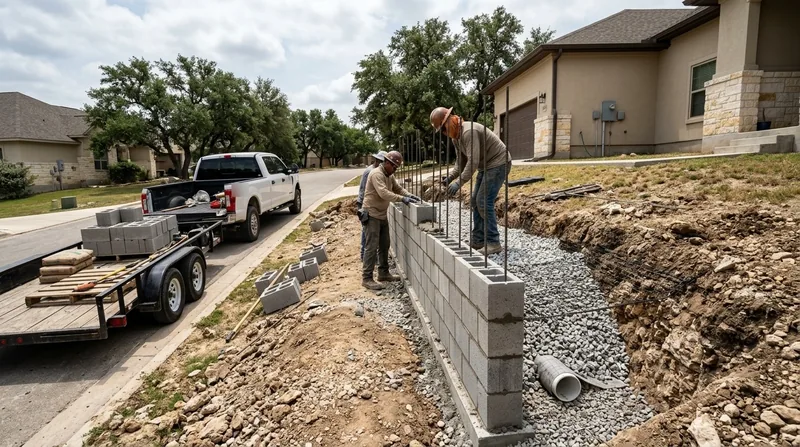




Concrete retaining walls in San Antonio are the engineered solution for hillside lots, driveway reinforcement, and clay-heavy properties that shift with seasonal moisture swings. San Antonio sits on the Balcones Escarpment, where thin rocky soil over Edwards limestone and caliche layers dominate the north side, while the South and East spread across expansive black clay that heaves after rain and cracks in drought. Poured concrete and reinforced CMU block walls handle these conditions better than timber or stacked stone because they anchor deep into stable footing, resist clay pressure, and shed water through engineered drainage. Whether your wall is leaning, cracked, or needs replacement after decades of sun and seasonal stress, a properly designed concrete wall stops the problem at the root. Read on to understand why concrete works in San Antonio's unique terrain, how we build them, and what to expect for your project.
Why Concrete Retaining Walls Matter in San Antonio's Hill Country and Clay Belt
San Antonio's geology creates two distinct retaining wall challenges. North of Loop 410, the Hill Country edge brings steep slopes, thin soils, and limestone bedrock that require walls anchored to stable footing deep into the caliche layer. South and East of downtown, expansive clay swells when wet and shrinks when dry, heaving and cracking walls that aren't reinforced and drained properly. Concrete walls, whether poured monolithic or built from reinforced CMU block, address both by distributing load over engineered footings, incorporating rebar for tensile strength, and using weep holes to manage subsurface water. Timber and stacked stone fail here within 10 to 15 years because they lack the mass and reinforcement to resist clay heave or the drainage to shed seasonal moisture.
- Concrete footings set below the frost line and into stable soil prevent heave and settlement that crack or tilt walls over time.
- Rebar and reinforcement mesh resist the outward pressure from clay, water, and surcharge loads like driveways or structures.
- Weep holes and drainage blankets behind the wall channel groundwater away, preventing hydrostatic pressure that pushes walls forward.
- Poured concrete and CMU block accept engineer-designed reinforcement patterns that timber and stone cannot match.
- A concrete wall rated for 8, 10, or 12 feet tall handles steep San Antonio lots where shorter walls would not solve the problem.
These factors make concrete the first choice for tall walls, clay lots, and properties where a wall failure means structural risk to a home, driveway, or neighboring property.
Key info: Many San Antonio neighborhoods, from Stone Oak and Shavano Park to Fair Oaks Ranch and Boerne, sit on slopes where a failing wall can expose Edwards limestone bedrock and trigger erosion. Concrete walls with proper drainage stop that cascade and protect your lot for 30 to 50 years.
For more on how walls fail and when repair becomes replacement, see our guide to leaning and collapsed wall repair in San Antonio.
How We Design and Build Concrete Retaining Walls in San Antonio
Every concrete wall we build starts with a site visit to assess soil type, slope angle, water drainage, and what the wall must support. On clay lots, we dig test pits to identify the depth of stable bearing soil and the extent of the caliche layer. On Hill Country properties, we confirm bedrock depth and existing drainage patterns. We then design the footing depth, rebar schedule, wall height, and drainage system, and we pull a permit from the local building department if the wall exceeds 4 feet from the footing or supports a surcharge. Once approved, we excavate, set forms or lay block, place rebar, pour concrete or grout, and install weep holes and a drainage blanket behind the wall.
- We perform a soil investigation and site survey to determine footing depth, bearing capacity, and existing drainage and slope.
- We design the wall height, rebar placement, and drainage system based on soil type, wall load, and local building code.
- We obtain all required permits from the City of San Antonio or the relevant jurisdiction before breaking ground.
- We excavate the footing trench to stable soil or bedrock, set forms or lay block, and place rebar and concrete or grout.
- We install weep holes every 4 to 6 feet horizontally and every 2 to 3 feet vertically to allow water behind the wall to drain.
- We backfill with a drainage blanket of gravel and filter fabric to prevent soil from clogging the weep holes.
This methodical approach ensures the wall will not heave, crack, or lean as San Antonio's seasons change and clay and water pressure shift.
Local example: A Monte Vista home on a 25-degree slope with a 1990s timber wall that was leaning 4 inches over 20 years. We removed the timber, dug 5 feet into clay to reach stable caliche, set a reinforced concrete footing, and poured a 10-foot engineered wall. Ten years later, zero movement, zero cracks. The key was depth and drainage, not shortcuts.
Learn more about our retaining wall installation process and the permitting requirements for your city.
Concrete Retaining Wall Methods: Poured vs. Block
| Approach | Description | Best for |
|---|---|---|
| Poured concrete monolithic | Continuous concrete wall cast in place with rebar, no joints or seams except at the footing and top. | Tall walls (8 to 15 feet), high water pressure, clay lots, areas with seismic or freeze-thaw stress. |
| Reinforced CMU block | Concrete masonry units stacked with rebar and grout filling the cores, creating a strong, modular wall. | Walls 6 to 10 feet, moderate slopes, areas where appearance or easier phasing matters, or where access limits large pour equipment. |
| Segmental block retaining wall | Interlocking concrete blocks without mortar, relying on weight and friction; includes geogrid reinforcement for strength. | Shorter walls (4 to 6 feet), aesthetic appeal, DIY-friendly appearance, areas where a modern look is desired. |
| Engineered hybrid (poured base plus block face) | A reinforced concrete footing and lower wall with CMU block facing on top, combining strength and appearance. | Walls 8 to 12 feet in subdivisions with aesthetic guidelines, properties where durability and finish both matter. |
Each method distributes load differently and responds to San Antonio's clay and slope pressures in distinct ways. Poured concrete excels on clay lots because its mass and monolithic design resist heave. CMU block works well on rocky Hill Country slopes where access for large concrete trucks is limited. We recommend the right method based on your soil, slope, and site constraints.
Concrete Retaining Walls Cost in San Antonio: What to Expect
Concrete retaining wall pricing in San Antonio starts at $35 per square foot for a straightforward poured or CMU block wall on stable soil with good access and no permitting delays. That ballpark covers the footing, rebar, concrete or block and grout, weep holes, and basic drainage blanket. A 10-foot-tall, 40-foot-long wall (400 square feet) would run roughly $14,000 to $18,000 before site prep, engineering, or permits. However, several factors move that number up or down significantly.
Soil type is the biggest cost driver. Clay lots requiring deeper footings, caliche removal, or extensive dewatering during construction add $5 to $15 per square foot. Hill Country properties with bedrock close to the surface may require rock removal or specialized drilling, adding $10 to $20 per square foot. A wall supporting a driveway or structure demands engineer-designed reinforcement and may require a geotechnical report, adding $1,500 to $3,000 upfront. Permitting and engineering drawings for walls over 4 feet add $500 to $2,000 depending on the city. Access constraints (narrow lots, no truck access, existing utilities) can add $5 to $10 per square foot for hand labor and smaller equipment.
The best way to understand your specific cost is to request a free estimate from us. We'll visit your property, assess the soil and slope, and provide a detailed quote with labor, materials, permits, and timeline. Call (726) 200-6830 or visit our pricing page for more detail on common scenarios.
Concrete Retaining Walls Near Me: What to Look for When Hiring a Contractor in San Antonio
Hiring the right contractor for a concrete retaining wall is as important as the wall itself. A poorly built wall will leak, lean, and fail within a decade. A well-built wall will last 30 to 50 years and protect your property through San Antonio's hot, dry summers and wet springs. When you're evaluating contractors in San Antonio, Alamo Heights, New Braunfels, Schertz, Cibolo, or any surrounding area, focus on these criteria. First, confirm that the contractor is licensed and insured. Ask to see a current Texas contractor's license and general liability and workers' compensation insurance. Second, ask for references from recent concrete wall projects in San Antonio and visit at least two completed jobs to inspect the quality of the footing, drainage, and finish. Third, get at least two or three written estimates that break down labor, materials, permitting, and timeline so you can compare apples to apples. Fourth, confirm that the contractor will pull all required permits from your local building department and will not start work without approval, because unpermitted work can create liability and resale problems.
- Verify the contractor holds a current Texas contractor's license and carries general liability and workers' compensation insurance.
- Request and visit references from at least two concrete retaining wall projects completed in the past two years in San Antonio.
- Obtain written estimates from at least two contractors that itemize labor, materials, permits, and timeline.
- Confirm that the contractor will handle all permitting and will not begin work without local building department approval.
- Ask whether the contractor will provide a warranty on the wall and for how long, and get the terms in writing.
A contractor who rushes the estimate, avoids talking about permits, or claims he can save money by skipping drainage is cutting corners that will cost you tens of thousands in repairs later. Take your time, ask hard questions, and choose a team that stands behind the work.
Ready to move forward? Contact us for a free estimate and we'll walk you through the entire process, no pressure and no surprises.
Concrete Retaining Walls in San Antonio: Pricing Guide
| Service | Price | Details |
|---|---|---|
| Standard concrete wall, stable soil | Starting at $35/sq ft | Poured or CMU block wall on firm soil with good access and straightforward drainage design |
| Clay lot or difficult soil | Starting at $45/sq ft | Deeper footings, caliche removal, dewatering, or geotechnical investigation required for San Antonio clay |
| Engineered wall with surcharge | Starting at $50/sq ft | Wall supporting driveway, structure, or utility; includes engineer-designed rebar and geotechnical report |
| Rock removal or Hill Country bedrock | Starting at $55/sq ft | Drilling, blasting, or specialized removal of Edwards limestone or caliche layers in Stone Oak or Boerne area |
| Permit, engineering, and site survey | Included to $2,000 | Local building department permit, engineer drawings, and soil investigation bundled or itemized based on wall height and complexity |
| Free estimate and consultation | Free | Site visit, soil assessment, and written quote with no obligation, response within 24 hours at (726) 200-6830 |
Indicative pricing, the exact cost depends on square footage, finish, and site access. Free personalized estimate within 24h at (726) 200-6830.


