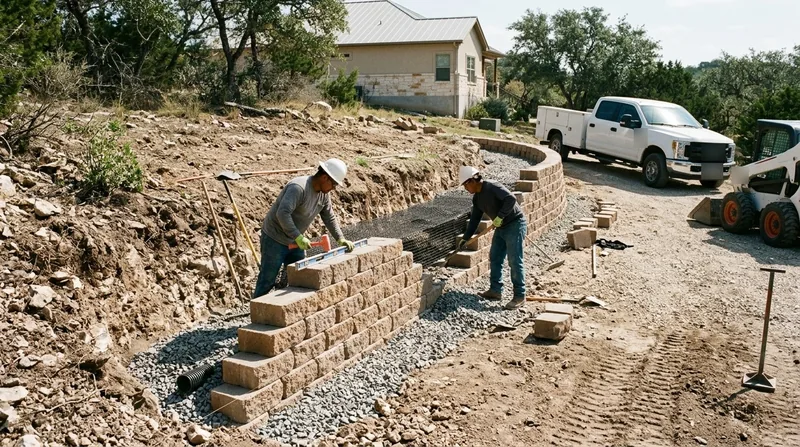




Retaining wall installation in San Antonio demands more than standard construction. The Balcones Escarpment cuts through the North Side with thin, rocky soil over Edwards limestone and caliche layers, while the South and East sides sprawl across black expansive clay that heaves after rain and cracks in drought. Driveways, terraced gardens, and slope stabilization on these soils require proper footings, gravel backfill, and drainage designed for local geology and flash flood risk. We build retaining walls that hold under South Texas sun, seasonal clay movement, and the hard stops that come with limestone bedrock. Whether you need to hold back a Hill Country slope in Shavano Park, stabilize a driveway in Stone Oak, or terrace a flat lot in Universal City, we start with site conditions, not generic specs.
Why Retaining Wall Installation Matters in San Antonio's Shifting Soils
San Antonio's geology creates specific wall failures. North of Loop 410, caliche layers and limestone bedrock force footings deep and demand drainage to prevent water pressure buildup. South and East of downtown, expansive clay swells when wet and shrinks in drought, pushing walls outward and tilting them over time. Flash flooding along creeks and draws in neighborhoods like Helotes and Boerne washes out backfill and undercuts footings. A wall built without understanding these pressures will lean, crack, or collapse within five to ten years. Professional installation captures the site's actual soil behavior, not assumptions.
- We excavate to stable soil or bedrock and set footings below frost and clay heave depth.
- We install gravel backfill and perforated drain pipe to shed water and prevent hydrostatic pressure.
- We size and angle walls for the specific surcharge (driveway, structure, or slope load) on your lot.
- We verify setbacks, property lines, and local permit thresholds before breaking ground.
- We build with materials that survive Texas heat, UV, and seasonal moisture swings (concrete, CMU block, engineered segmental systems, or stacked limestone).
Proper installation stops the lean, erosion, and foundation damage that plague aging timber and poorly drained walls across San Antonio.
Key info: Many San Antonio jurisdictions require a permit for walls over 4 feet or walls supporting a driveway or structure. Tall or tiered walls may need engineered drawings. Always check with your local building department before starting, as rules vary by city and neighborhood. See the leaning and collapsed wall repair service if your existing wall is already failing.
For detailed permitting guidance specific to your address, contact the San Antonio Development Services Department or your local city building office.
How We Install Retaining Walls in San Antonio: From Site Survey to Finished Wall
Every wall starts with a site visit. We assess soil type, slope angle, drainage patterns, proximity to structures, and any existing utilities or tree roots. We measure the cut and fill heights, verify property lines and setbacks, and determine whether a permit or engineer is required. Then we design the wall for that specific lot and build it in phases that control water, secure footings, and ensure long-term stability.
- We excavate the footing trench to stable soil or bedrock, removing caliche or clay as needed.
- We set a compacted gravel base and pour a concrete footing or compact a gravel footing, depending on soil and wall type.
- We build the wall face using your chosen material (concrete, CMU, segmental block, stacked limestone, or timber).
- We install perforated drain pipe behind the wall and backfill with gravel to shed water and prevent pressure buildup.
- We compact backfill in lifts and finish the top with a cap or bond beam for durability and appearance.
- We grade and slope the ground away from the wall to direct surface water away from the footing.
This sequence ensures the wall drains, the footing stays stable, and the structure resists clay heave, limestone settlement, and flood stress for decades.
Local example: A homeowner in Alamo Heights had a 6-foot slope behind their driveway on black clay soil. Seasonal swelling was pushing an old timber wall outward. We excavated to 4 feet below grade, set a concrete footing, built a 6-foot poured concrete wall with a 6-inch setback (batter), installed drain pipe and gravel backfill, and capped it with a finished bond beam. The wall has held steady through two drought cycles and three heavy rain seasons. Total time: 8 working days. See our concrete retaining walls service for more examples and material options.
Retaining Wall Installation Methods in San Antonio
San Antonio homeowners choose between several proven approaches, each suited to different soils, budgets, and aesthetics. The right method depends on wall height, the load it bears, the soil it sits on, and your timeline and budget.
| Approach | Description | Best for |
|---|---|---|
| Poured Concrete | Monolithic concrete wall cast in place on a concrete footing. High strength, no joints, fully customizable height and batter. | Tall walls (6 to 12 feet), high surcharge loads, areas with clay heave or poor drainage. |
| CMU Block | Stacked concrete masonry units with a grouted core and rebar for reinforcement. Modular, quick to build, good aesthetic range. | Walls 4 to 8 feet, moderate loads, residential lots in Stone Oak, Shavano Park, and Alamo Heights. |
| Segmental Block (SRW) | Engineered interlocking blocks with built-in batter, geogrid reinforcement, and a gravel core. Flexible, fast to install, great for slopes. | Tiered walls, slope stabilization, decorative finishes, residential terracing in Hill Country neighborhoods. |
| Stacked Limestone or Boulder | Natural cut or stacked Texas limestone, or large boulders set in mortar or dry-stacked. High aesthetic appeal, variable durability depending on stone quality and footing depth. | Heritage homes in King William and Monte Vista, Hill Country aesthetics, shorter walls (3 to 5 feet) on stable soil. |
| Timber (Pressure-Treated or Railway Ties) | Horizontal or vertical timbers pinned with rebar. Quick to install, rustic appearance, limited lifespan (10 to 20 years in Texas heat and moisture). | Low to moderate walls (2 to 4 feet), temporary or rustic applications. Rarely recommended for new builds due to decay risk in San Antonio climate. See railroad tie wall replacement for aging timber wall repairs. |
We assess your site and recommend the method that balances cost, durability, aesthetics, and local soil behavior. A free estimate includes material options and honest advice on long-term performance.
Retaining Wall Installation Cost in San Antonio: What to Expect
Retaining wall installation costs in San Antonio typically start at $30 per square foot for straightforward CMU block or segmental walls on accessible sites with stable soil. Poured concrete walls and natural stone run higher. Tall walls, tiered designs, poor site access, difficult soil (deep caliche, bedrock), drainage complications, and permit or engineering requirements all add cost. A 100-square-foot wall (say, 10 feet long and 10 feet tall) might range from $3,000 to $8,000 depending on method and conditions. A 300-square-foot tiered system or a tall concrete wall with engineered design could run $12,000 to $25,000 or more.
The best way to know your actual cost is to get two to three estimates from licensed contractors who visit your site. Each will assess soil, access, drainage needs, and material choice and give you a firm quote. We provide a free, no-obligation estimate within 24 hours. Call us at (726) 200-6830 or visit our pricing page for typical ranges by wall type and size. Factors that move cost up include deep excavation to bedrock, poor site access requiring hand labor or smaller equipment, proximity to structures or utilities, engineered designs for tall or tiered walls, and complex drainage or slope stabilization. Factors that move cost down include straightforward access, shallow footings on stable soil, simple single-wall designs, and material choices like CMU block versus poured concrete.
Never hire based on price alone. A wall that fails in three years costs far more in repairs and property damage than a properly built wall costs upfront. Choose a licensed, insured contractor with local references and a warranty on materials and workmanship.
Retaining Wall Installation Near Me: What San Antonio Homeowners Should Know When Hiring a Contractor
Finding the right contractor for retaining wall installation in San Antonio starts with three non-negotiable checks. First, verify the contractor is licensed and insured Ask for proof of insurance and a certificate of workers' compensation. Second, ask for at least three local references from completed walls in your neighborhood or similar soil type. Call those references and ask how the wall has held up over time and whether the contractor addressed drainage, permits, and cleanup. Third, get multiple written estimates from different contractors and compare scope, materials, timeline, and warranty, not just price.
Other key points:
- Confirm the contractor understands San Antonio's soil types (clay, caliche, limestone) and can explain why drainage and footing depth matter for your specific lot.
- Verify the contractor will handle or coordinate permits with your local building department and can name the threshold that triggers a permit requirement in your jurisdiction.
- Ask whether the contractor will provide an engineered design or work with an engineer if your wall is tall or tiered or supports a structure.
- Check for HOA or neighborhood architectural guidelines that may require approval of wall materials, height, or setback before construction starts.
- Confirm the contractor provides a written warranty covering materials and workmanship for at least one year, and ask what happens if the wall settles, cracks, or leans after installation.
A professional contractor will answer all these questions upfront and provide references you can trust. If a contractor rushes you, avoids discussing permits or drainage, or quotes a price that seems too low, move on to the next estimate.
Ready to get started? Contact us for a free estimate. We serve San Antonio, Alamo Heights, New Braunfels, Schertz, Cibolo, Converse, Universal City, Live Oak, Boerne, Helotes, Leon Valley, Seguin, Floresville, Castroville, Fair Oaks Ranch, and Bulverde. Call (726) 200-6830 or fill out our online form, and we will respond within 24 hours with a time to meet at your property.
Retaining Wall Installation in San Antonio: Pricing Guide
| Service | Price | Details |
|---|---|---|
| CMU Block Wall | Starting at $30/sq ft | Straightforward 4 to 6-foot walls on accessible sites with stable soil and standard drainage requirements included |
| Segmental or SRW Block Wall | Starting at $35/sq ft | Tiered designs, slope stabilization, and decorative finishes with geogrid and engineered backfill included |
| Poured Concrete Wall | Starting at $45/sq ft | Tall walls, high surcharge loads, poor soil conditions, or complex drainage requiring monolithic concrete and custom formwork |
| Natural Stone or Boulder Wall | Starting at $50/sq ft | Stacked limestone or boulder work with mortar and experienced stone masonry, higher material and labor cost for heritage aesthetics |
| Engineered Design or Permit | On estimate | Tall walls over 8 feet, tiered multi-wall systems, or walls supporting structures require professional engineering drawings and site-specific calculations |
| Free Estimate | No charge | Site visit, soil assessment, material recommendations, and written quote within 24 hours with no obligation to book |
Indicative pricing, the exact cost depends on square footage, finish, and site access. Free personalized estimate within 24h at (726) 200-6830.


