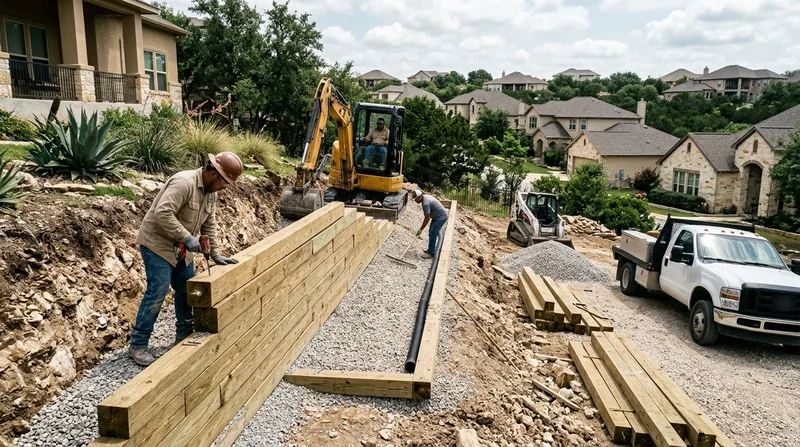




Timber retaining walls in San Antonio offer an affordable, attractive solution for garden beds, low terraces, and landscape transitions across the Hill Country edge and flat South Side neighborhoods. Whether you're working with the thin rocky soil and limestone layers north of Loop 410 in Stone Oak and Helotes, or the expansive black clay that swells and cracks on the East and South Sides, pressure-treated timber provides a budget-conscious option when installed correctly. San Antonio's intense sun, occasional heavy rains along creeks and draws, and the clay heave that affects countless foundations mean timber walls demand proper drainage, solid footing, and realistic expectations about lifespan. We install, repair, and replace timber walls across San Antonio, Alamo Heights, New Braunfels, and surrounding areas, and we're honest about when timber makes sense and when a longer-lasting material like concrete or stone is the smarter investment for your property.
Why Timber Retaining Walls Matter in San Antonio's Challenging Climate
San Antonio sits at the edge of the Balcones Escarpment, where the landscape shifts dramatically from rocky Hill Country terrain to flat, clay-heavy ground. Retaining walls are essential infrastructure here, not decorative extras. When clay swells after rain or cracks open during drought, walls shift and fail. Flash floods along creeks and draws in neighborhoods like Fair Oaks Ranch and Boerne scour footings and topple unsupported structures. A well-built timber wall, when properly drained and footed below the frost line, stabilizes slopes, prevents erosion, and creates usable terraces. Timber offers a real cost advantage over concrete or stone, but only when the application is right and the builder understands local soil and water behavior.
- Timber walls work best for garden beds, low terraces, and decorative landscape features under 4 feet in height.
- Proper drainage is critical in San Antonio clay, where standing water behind a wall accelerates rot and structural failure.
- Pressure-treated lumber resists decay longer than untreated wood, but will eventually need replacement in our hot, humid climate.
- We set footings below grade to prevent heave from clay expansion and frost action.
- Timber walls require inspection every 2 to 3 years, especially after heavy rain or drought cycles.
These factors make timber a practical choice for homeowners who understand its limits and maintain it proactively.
Key info: In neighborhoods like Monte Vista and King William, older timber walls supporting Victorian and 1920s homes often fail because the original footings sit directly on caliche or shallow soil without drainage. We remove failed timber walls and replace them with engineered solutions that account for San Antonio's clay and limestone bedrock.
For more information on wall failure and repair, see our retaining wall repair page or contact us at (726) 200-6830 for an inspection.
How We Install and Repair Timber Retaining Walls in San Antonio
Our process starts with a site assessment to understand soil type, drainage patterns, and whether the wall will support a surcharge such as a driveway or structure. We mark property lines, verify setback requirements with the local building department (thresholds vary by jurisdiction), and check for HOA restrictions in subdivisions like Shavano Park and Helotes. Once we confirm the scope, we excavate the footing trench, compact the base, and set pressure-treated posts or timber stringers below grade with proper gravel drainage on the downslope side. We backfill with native soil or amended material and compact in lifts to prevent settling.
- We assess soil type, clay content, and existing drainage to choose the right footing depth and drainage strategy.
- We excavate below frost line (typically 12 to 18 inches in San Antonio) to prevent heave from clay expansion.
- We install gravel or perforated drain pipe behind the wall to direct water away from the timber.
- We backfill in 6-inch lifts and compact each layer to eliminate voids that trap moisture.
- We set horizontal stringers level and vertical posts plumb, using stainless steel fasteners to resist rust in our climate.
- We inspect the wall at completion and provide a maintenance schedule to extend its lifespan.
This methodical approach prevents the settling, tilting, and rot that plague hastily built timber walls across San Antonio.
Real example: A homeowner in Converse had a 3-foot timber garden wall that tilted inward after two seasons because the original builder set the footing on caliche without drainage. We removed the wall, excavated 18 inches into stable soil, installed a perforated drain line, and rebuilt it with pressure-treated 6x6 posts and 2x10 stringers. The wall has held true for five years and counting.
For comprehensive information on retaining wall installation techniques and design, visit our retaining wall installation page.
Timber Retaining Wall Installation Methods and Materials
| Approach | Description | Best for |
|---|---|---|
| Pressure-Treated Timber (Standard) | Kiln-dried lumber treated with copper-based preservatives to resist decay and insects. Posts are typically 6x6 or 8x8, stringers are 2x10 or 2x12. Fasteners are stainless steel or hot-dipped galvanized. | Garden beds, low terraces, landscape transitions under 4 feet. Budget-conscious homeowners in San Antonio who maintain the wall every 2 to 3 years. |
| Composite or Recycled Plastic Lumber | Engineered blend of recycled plastic and wood fiber. Resists rot, insects, and UV degradation. Slightly higher upfront cost but requires minimal maintenance over 15 to 20 years. | Homeowners in high-moisture areas or who prefer minimal maintenance. Works well on clay-heavy South and East Side properties prone to standing water. |
| Timber with Integrated Geotextile and Drainage | Standard pressure-treated posts and stringers combined with geotextile fabric and perforated drain pipe to manage water behind the wall. Extends timber lifespan by 5 to 10 years in San Antonio clay. | Properties with poor natural drainage, clay expansion concerns, or proximity to creeks and draws. Neighborhoods like Universal City and Live Oak with flat terrain and clay-heavy soil. |
| Timber Wall Replacement (Failed or Leaning) | Complete removal of failed or leaning timber walls, excavation of the footing area to stable soil, and installation of a new wall with corrected drainage and footing depth. May include conversion to concrete or stone if timber is not suitable. | Walls that have tilted, rotted, or settled after 8 to 15 years. Homeowners who want a permanent solution or need a taller, load-bearing wall supporting a structure. |
Timber Retaining Walls Cost in San Antonio: What to Expect
Timber retaining wall installation in San Antonio typically starts at $20 per square foot for a straightforward garden wall with standard pressure-treated lumber and basic drainage. The final cost depends on wall height, soil type, footing depth, drainage complexity, and site access. A 3-foot-tall wall running 30 feet long would be roughly 90 square feet, putting the base cost in the $1,800 to $2,500 range before permits or site prep. Walls taller than 4 feet, walls supporting a driveway or structure, and walls built on steep slopes with clay heave concerns will cost more because they require deeper footings, additional drainage infrastructure, and possibly engineered drawings. Getting two or three estimates from licensed contractors is smart practice, because soil conditions vary dramatically across San Antonio. A wall in Stone Oak on rocky Hill Country soil may cost less than the same wall on clay-heavy ground in Converse or Live Oak, where drainage work is more extensive.
For detailed pricing information and to request a free estimate, visit our pricing page or call (726) 200-6830. We respond within 24 hours.
Timber Retaining Walls Near Me: What San Antonio Homeowners Should Know Before Hiring
Hiring the right contractor for timber retaining wall installation or repair is as important as choosing the right material. Look for a company that is licensed and insured, holds a current contractor's license from the State of Texas, and carries general liability and workers' compensation coverage. Ask for references from recent jobs in your neighborhood, whether Helotes, Alamo Heights, or Live Oak, and call those homeowners to ask about quality, cleanup, and how the wall has performed over time. Understand that walls above 4 feet or supporting a surcharge typically require a permit from your local building department, and some jurisdictions require engineered drawings. If your property is in an HOA community like Fair Oaks Ranch or Shavano Park, check covenants and restrictions before you start. A reputable contractor will verify setbacks, obtain permits on your behalf, and coordinate with the city. Avoid contractors who offer rock-bottom prices or promise to skip permitting, because unpermitted work can create liability, insurance disputes, and costly removal orders from the city.
- Verify that your contractor holds a current Texas contractor's license and carries general liability and workers' compensation insurance.
- Request three references from completed timber wall projects in San Antonio within the past two years.
- Ask whether the estimate includes soil testing, drainage design, and permit coordination.
- Confirm setback and property-line requirements with your local building department before signing a contract.
- Review your HOA covenants if applicable, and ensure the contractor understands your subdivision's restrictions.
- Get the estimate in writing, including materials, labor, drainage, and any site prep or removal work.
A clear, detailed estimate and open communication prevent misunderstandings and ensure your timber wall is built to last.
Ready to move forward? Contact us today for a free, no-obligation estimate. We serve San Antonio, Alamo Heights, New Braunfels, Schertz, and surrounding areas.
Timber Retaining Walls in San Antonio: Pricing Guide
| Service | Price | Details |
|---|---|---|
| Timber retaining wall installation (standard pressure-treated lumber) | Starting at $20/sq ft | Includes excavation, footing, posts, stringers, fasteners, and basic gravel drainage for walls under 4 feet |
| Timber wall with integrated drainage and geotextile | Starting at $28/sq ft | Adds perforated drain pipe, geotextile fabric, and enhanced backfill to manage clay expansion and standing water |
| Composite or recycled plastic lumber wall | Starting at $35/sq ft | Longer lifespan and minimal maintenance over 15 to 20 years, ideal for high-moisture San Antonio clay properties |
| Failed or leaning timber wall removal and replacement | On estimate | Scope depends on wall height, footing condition, soil type, and whether conversion to concrete or stone is recommended |
| Permit and engineering fees (if required) | On estimate | Walls above 4 feet or supporting a surcharge typically need permits and may require engineered drawings from a professional engineer |
| Free estimate and site assessment | No charge | We inspect soil, drainage, and site conditions, provide a detailed written estimate, and respond within 24 hours at (726) 200-6830 |
Indicative pricing, the exact cost depends on square footage, finish, and site access. Free personalized estimate within 24h at (726) 200-6830.


