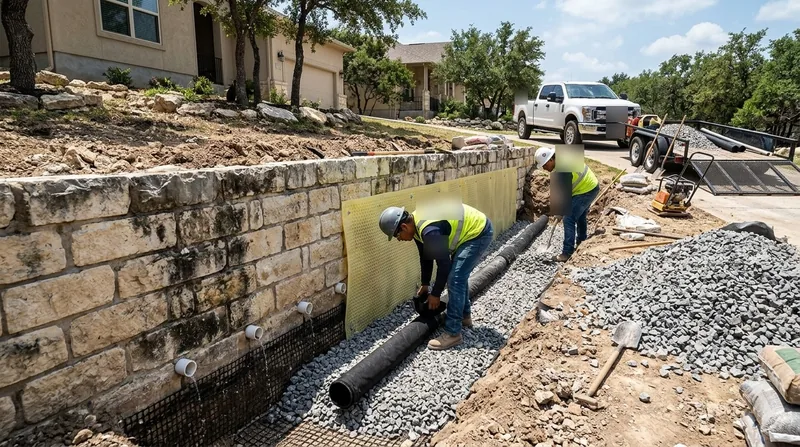




Retaining Wall Drainage in San Antonio is not a luxury add-on, it is the backbone of a wall that lasts. San Antonio sits on the Balcones Escarpment, where the Hill Country's thin rocky soil and Edwards limestone meet the South and East Sides' black expansive clay that swells after heavy rain and cracks open in drought. Flash floods sweep through creeks and draws under hard, bright sun. When water builds up behind a retaining wall, hydrostatic pressure takes over, and concrete, block, limestone, or timber fails fast. Proper drainage, installed from the start or retrofitted to a failing wall, stops that pressure before it cracks your foundation or sends a hillside into your neighbor's yard. We design and install drainage systems that work in San Antonio's specific soil and weather conditions, keeping your wall stable for decades.
Why Retaining Wall Drainage Fails in San Antonio and How to Fix It
San Antonio's biggest wall enemy is water trapped behind the wall. The black clay soils on the South and East Sides hold moisture like a sponge, and the Hill Country limestone and caliche layers north of Loop 410 shed water downslope into walls. When rain comes, it comes fast and hard. A wall without drainage becomes a dam. Hydrostatic pressure builds, concrete and block crack, footings settle, and walls lean or collapse. Even walls built 20 or 30 years ago without modern drainage systems are failing now as clay heave and freeze-thaw cycles take their toll.
- We install French drains at the base of the wall to capture and redirect water away from the footing.
- We drill weep holes through block or concrete to let water escape before pressure builds inside the wall.
- We lay perforated drain pipe behind the wall in gravel backfill to channel water down and away from the structure.
- We apply waterproofing membranes to the back face to stop water from soaking into concrete and block.
- We specify free-draining backfill, not clay, so water moves through the soil instead of sitting against the wall.
These systems work together to relieve hydrostatic pressure, the number one cause of retaining wall failure in San Antonio's flash flood country.
Key info: A wall in Alamo Heights or Stone Oak that leans outward at the top, or shows horizontal cracks near the middle, is telling you water is pushing it. If you see white mineral stains or wet spots at the base, hydrostatic pressure is active right now. Call us at (726) 200-6830 for an inspection.
For more detail on how walls fail and what repair looks like, see our page on leaning and collapsed wall repair.
How We Install Retaining Wall Drainage in San Antonio: Step-by-Step Process
Drainage design starts before the first shovel turns. We assess the soil type, the height and length of the wall, the slope above it, and how water moves across your property. In areas like Leon Valley or Bulverde where limestone outcrops and caliche layers are common, we may need to break through hard layers to reach proper footing depth. On the flat South Side, we focus on moving water sideways and down, away from the wall footing. Every job is different, and we build the system to match the site.
- We excavate behind the wall to expose the back face and remove old, water-logged backfill if needed.
- We install perforated drain pipe in a gravel trench, sloped to daylight or to a storm drain, so water flows away by gravity.
- We apply a waterproofing membrane to the back of concrete or block to stop capillary moisture from rising into the wall.
- We backfill with clean, free-draining gravel or engineered fill, not clay or site soil.
- We drill weep holes at the base or lower sections of the wall to let internal moisture escape.
- We grade the surface above the wall to slope away and direct roof and surface runoff away from the wall.
The entire system is designed to move water away from the wall before pressure builds, keeping your wall dry and stable for 30 years or more.
Example: A homeowner in Fair Oaks Ranch had a 12-foot limestone wall that was leaning after two seasons of heavy rain. We excavated behind it, found clay backfill and a crushed drain pipe from the original build. We installed new perforated drain pipe, gravel backfill, and waterproofing membrane on the back face. Weep holes were drilled every 4 feet. The wall stabilized within weeks, and moisture stopped appearing in the crawlspace below.
If your wall is part of a larger slope or erosion issue, we also offer slope stabilization and erosion control to protect your property long-term.
Drainage Methods for Retaining Walls: What Works in San Antonio
| Approach | Description | Best for |
|---|---|---|
| French Drain System | Perforated pipe buried in gravel at the wall base, sloped to daylight or drain outlet. Intercepts water moving downslope and channels it away. | Any wall with water seepage or wet backfill. Standard for new walls in San Antonio. |
| Weep Holes and Filters | Holes drilled or cast into the wall face, typically 4 feet apart, lined with filter fabric to let water escape without soil loss. | Concrete, block, and stone walls where internal moisture is already present or expected. |
| Waterproofing Membrane | Liquid or sheet membrane applied to the back face of the wall to stop water infiltration and capillary rise into concrete or block. | Poured concrete and CMU walls, especially in areas with high groundwater or clay soil expansion. |
| Gravel Backfill and Geotextile | Clean, angular gravel (no clay) placed behind the wall with geotextile filter fabric to allow water movement while preventing soil migration. | All walls. Especially critical in San Antonio's clay soils to prevent clay heave and saturation. |
| Surface Grading and Swales | Slope the ground surface away from the wall and install shallow swales upslope to intercept runoff and direct it away from the wall. | Every wall, especially on the Hill Country slopes where heavy rain concentrates on hillsides. |
We combine these methods based on your wall's material, height, soil conditions, and the water patterns we observe at your property. A concrete wall in Stone Oak may need a full French drain plus waterproofing. A block wall in Leon Valley might focus on weep holes and gravel backfill. We assess and recommend.
Retaining Wall Drainage Cost in San Antonio: What to Expect
Retaining wall drainage cost in San Antonio typically starts at $2,500 for a basic French drain system on a 30- to 40-foot wall. That covers excavation, perforated pipe, gravel backfill, and proper slope to daylight. Longer walls, taller walls, walls in rocky soil, or walls requiring multiple drainage methods and waterproofing will cost more. Access to the wall, soil type, whether the wall is existing or new construction, and the distance to daylight all affect the final price.
A wall in Schertz or Converse with flat terrain and deep clay may need a longer drain run or a sump pump, adding $1,000 to $2,500. A wall in Helotes or Boerne cut into limestone may require jackhammer work to break caliche and reach proper footing, adding $500 to $1,500. Waterproofing a full concrete wall back face can add $800 to $1,500 depending on size. Weep hole drilling and filter installation typically runs $300 to $600 per wall section.
We always recommend getting 2 to 3 estimates from licensed contractors so you can compare methods and pricing. Some crews will install a minimal system; others will overspec and charge for work you don't need. We design to your site conditions and budget, and we explain why each part of the system is there.
For a detailed breakdown by wall type and size, visit our pricing page. Call us at (726) 200-6830 for a free, no-obligation estimate tailored to your property.
Retaining Wall Drainage Near Me: What San Antonio Homeowners Should Know When Hiring
When you search for retaining wall drainage contractors near you in San Antonio, Alamo Heights, New Braunfels, or any of our service areas, look for three things: a license and proof of insurance, a willingness to pull permits if the wall is tall or supports a surcharge like a driveway, and references from recent jobs. San Antonio and surrounding cities have varying permit thresholds, typically around 4 feet measured from footing, and some jurisdictions require engineered drawings for tiered or tall walls. A contractor who skips the permit conversation is cutting corners.
Ask for photos of completed jobs, especially drainage work. Ask if they have experience with San Antonio's specific soil conditions: black clay on the South Side, limestone and caliche on the North and Hill Country, and the flash flood patterns that make drainage critical. Check references and ask about warranty on the drainage system itself, not just the wall. A good crew will stand behind their weep holes and drain pipes for at least 5 years.
If your wall is in an HOA community, check whether the HOA has rules on wall height, material, or setbacks. If the wall is near a property line, verify setback requirements with the local building department. These rules vary by city, so always call ahead or ask us to check. We handle permitting conversations and can coordinate with your city or HOA.
Ready to protect your wall? Contact us for a free inspection and estimate. We serve San Antonio, Alamo Heights, New Braunfels, Schertz, Cibolo, Converse, Universal City, Live Oak, Boerne, Helotes, Leon Valley, Seguin, Floresville, Castroville, Fair Oaks Ranch, and Bulverde. Call (726) 200-6830 or fill out our online form, and we will respond within 24 hours.
For additional context on retaining wall installation and how drainage is built into new walls from day one, visit our installation page.
Retaining Wall Drainage in San Antonio: Pricing Guide
| Service | Price | Details |
|---|---|---|
| French Drain System | Starting at $2,500 | Perforated pipe, gravel backfill, and proper slope to daylight on 30-40 foot wall section |
| Weep Hole Installation | Starting at $300-$600 | Drilling and filter installation, typically 4-6 holes per 30-foot wall section depending on wall height |
| Waterproofing Membrane Application | Starting at $800-$1,500 | Liquid or sheet membrane on concrete or CMU wall back face, cost varies by wall square footage and membrane type |
| Gravel Backfill and Geotextile | Starting at $400-$900 | Clean angular gravel and filter fabric installation behind wall, pricing depends on wall length and depth of backfill required |
| Complex Drainage or Retrofit | On estimate | Multi-method systems, sump pumps, rocky soil excavation, or existing wall repairs require on-site assessment before pricing |
| Free Estimate | No charge | Response within 24 hours, includes site inspection, soil and water assessment, and written recommendation with budget |
Indicative pricing, the exact cost depends on square footage, finish, and site access. Free personalized estimate within 24h at (726) 200-6830.


