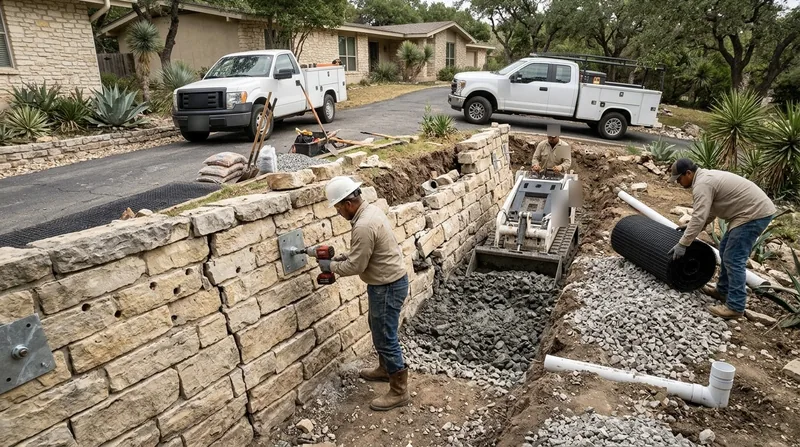




Retaining Wall Repair in San Antonio demands fast action when you notice cracks, leaning, or settling. The Hill Country sits on the Balcones Escarpment, where thin rocky soil over Edwards limestone meets steep grades in neighborhoods like Stone Oak and Helotes, while the South and East Sides spread across black expansive clay that heaves after rain and cracks open in drought. Walls fail here from clay expansion, footings set on caliche without proper drainage, and sudden flash floods along creeks and draws under South Texas heat. A wall that leans today can collapse tomorrow, taking soil, landscaping, and sometimes structures with it. We stop that failure before it happens, with drainage correction, tieback anchors, and targeted rebuilds that restore stability and protect your property. Call us at (726) 200-6830 for a free estimate, or learn more about our leaning and collapsed wall repair services.
Why Retaining Wall Repair Matters in San Antonio's Clay and Limestone Terrain
San Antonio's geology and climate create perfect conditions for wall failure. Expansive clay swells when wet and shrinks when dry, pushing walls outward and cracking them from the inside out. Limestone footings set directly on caliche without a gravel base trap water, weakening the footing and allowing the wall to settle unevenly. Flash floods from the creeks and draws that cut through our neighborhoods can undermine walls in hours, especially in areas like Live Oak and Cibolo where drainage is poor. Ignoring early signs like small cracks, slight bows, or water seeping from behind the wall turns a repair into a replacement, costing three to five times more.
- Expansive clay heave pushes walls outward and creates horizontal cracks that widen over months.
- Water trapped behind a wall without proper drainage erodes the backfill and destabilizes the footing.
- Settling caused by poor compaction or caliche layers leaves walls tilted and unsafe.
- Flash flooding in South Texas undermines footings and erodes soil support in hours.
- Roots from trees or landscape plantings near the wall can crack concrete and push stone or block out of plumb.
Catching these problems early saves money and prevents injury or property damage. Verify permit requirements with your local building department, as many San Antonio jurisdictions require a permit for walls over 4 feet or walls that support a surcharge like a driveway. Visit the City of San Antonio official website for current code thresholds and setback rules.
Key info: A wall leaning 1 to 2 inches in 10 feet is already at risk. If you can fit a ruler blade into horizontal cracks or see water weeping from the base, call us immediately. These are not cosmetic issues, they are structural warnings.
How We Repair Retaining Walls in San Antonio: Our Process
Every wall repair starts with a clear diagnosis. We inspect the wall's angle, measure settlement, check for water behind it, and dig or probe the footing to see what's actually holding it up. In San Antonio's clay and limestone mix, we often find footings that were never set deep enough, or caliche layers that trap water instead of draining it. We photograph everything, explain what failed and why, and show you exactly what we will do to fix it. Then we get to work with methods tailored to your wall's material, the soil type, and the failure mode.
- We excavate and inspect the footing and backfill to identify the root cause of movement or cracking.
- We install or repair drainage systems, including perforated pipe, gravel, and weep holes to stop water from building up behind the wall.
- We add tieback anchors, soil nails, or helical anchors to resist clay heave and hold walls in place.
- We rebuild sections of the wall that are too damaged to patch, using the same material and engineering standards as the original.
- We compact and monitor the backfill to ensure proper settlement and long-term stability.
Most repairs take 2 to 5 days depending on the wall's size and the scope of work. If your wall also needs drainage correction or slope stabilization, we handle that as part of the repair.
Example: A homeowner in Alamo Heights noticed a 3-inch bow in a 6-foot limestone wall after heavy spring rains. We dug the footing, found it sitting on caliche without any gravel base, and saw water pooling behind the wall. We installed a full drainage system with perforated pipe and gravel, added two tieback anchors, and reset the backfill. The wall is now plumb and dry, and the homeowner avoided a full replacement that would have cost $8,000 more.
Retaining Wall Repair Methods: Which Approach Works for Your Wall
| Approach | Description | Best for |
|---|---|---|
| Drainage Repair | Install or replace perforated drain pipe, add gravel backfill, and drill weep holes to release water pressure behind the wall. | Walls with seepage, water pooling, or soft backfill. Most common fix in San Antonio due to clay and caliche layers. |
| Tieback Anchors | Drive steel anchors through the wall into stable soil or rock behind it, then tension them to pull the wall back to plumb. | Leaning or bowing walls where the footing is sound but clay heave or water pressure is pushing the wall outward. |
| Helical Anchors | Install helical (screw) anchors deep into stable soil or limestone, then use them to anchor straps or cables that brace the wall. | Tall walls, walls on slopes, or situations where traditional anchors cannot be installed or tensioned safely. |
| Partial or Full Rebuild | Remove the damaged section, reset the footing on proper gravel base, rebuild with the same or reinforced material, and compact the backfill. | Walls with severe cracking, large voids, or multiple failure points. Often paired with drainage and anchoring. |
| Underpinning and Footing Repair | Excavate deeper, pour a new reinforced concrete footing or grade beam, and set the wall on solid, well-drained support. | Walls that have settled, shifted, or were built on inadequate footings. Common in older San Antonio neighborhoods. |
The right approach depends on your wall's material, the soil behind and below it, and what caused the failure. We never guess. Our inspection tells us exactly what will work and what will last.
Retaining Wall Repair Cost in San Antonio: What to Expect
Repair costs in San Antonio typically start at $1,500 for simple drainage fixes or minor crack repair on a wall under 4 feet tall and in good access. A wall that needs tieback anchors, full drainage work, or partial rebuilding runs $3,500 to $7,500 depending on the wall's height, length, material, and how deep the failure goes. Large walls, walls on steep slopes, or walls that need full reconstruction can run $10,000 to $20,000 or more. The biggest cost drivers are the wall's length and height, how hard it is to reach (access and equipment), the soil and footing condition, and whether the wall needs engineering or permits.
Always get 2 to 3 estimates from licensed contractors. A low bid often means shortcuts that will fail again in a year or two. A good estimate includes a site visit, photos, a clear scope of work, the materials being used, and a timeline. Watch out for contractors who quote over the phone without seeing the wall, or who promise a fix without understanding the soil and drainage.
For a full pricing breakdown and examples of common repair scenarios, visit our pricing page. Call us at (726) 200-6830 for a free estimate. We respond within 24 hours and will give you a real number based on what your wall actually needs.
Retaining Wall Repair Near Me: What San Antonio Homeowners Should Know When Hiring a Contractor
Choosing the right contractor for retaining wall repair is not a price competition, it is a trust decision. Your wall holds back soil and protects your home, your landscaping, and your safety. A bad repair will fail, often in the same way as before, and cost you twice as much to fix the second time. Look for a contractor who is licensed and insured, who has done this work in San Antonio's specific soil and climate, and who can show you references from recent jobs in your neighborhood or a similar area like Alamo Heights, Stone Oak, or Live Oak.
- Ask for at least three references from homeowners in the San Antonio area whose walls were repaired in the last two years.
- Confirm that the contractor understands local building codes and permitting. Many walls over 4 feet require a permit, and your contractor should pull it and coordinate with the city.
- Check whether your HOA or property deed has restrictions on wall materials or height. Some San Antonio neighborhoods require engineered drawings or specific materials.
- Get the estimate in writing, with a breakdown of labor, materials, drainage work, anchoring, and any permits or engineering fees.
- Ask how the contractor will handle unexpected conditions, like hitting rock or finding poor soil. A good contractor has a plan and will contact you before changing the scope.
We pull permits when required, explain what we find, and stand behind our work with a warranty. Contact us today for a free, no-obligation estimate and a straight answer about what your wall needs.
Retaining Wall Repair in San Antonio: Pricing Guide
| Service | Price | Details |
|---|---|---|
| Drainage Repair and Weep Hole Installation | Starting at $1,500 | Includes drain pipe installation, gravel backfill, and weep holes for walls under 30 feet long without excavation |
| Tieback Anchor Installation | Starting at $2,500 | Includes anchors, tensioning, and testing for walls with minor to moderate bowing or clay heave pressure |
| Partial Wall Rebuild with Drainage | Starting at $4,500 | Includes removal and rebuild of damaged section, new footing, drainage system, and compaction for 10 to 20 linear feet |
| Full Wall Reconstruction or Large Repair | On estimate | Walls over 30 feet, full height rebuilds, severe settling, or complex slope conditions require on-site inspection and engineered design |
| Travel and Estimate | Free | No charge for estimate or travel within San Antonio and surrounding service areas, response within 24 hours |
Indicative pricing, the exact cost depends on square footage, finish, and site access. Free personalized estimate within 24h at (726) 200-6830.


