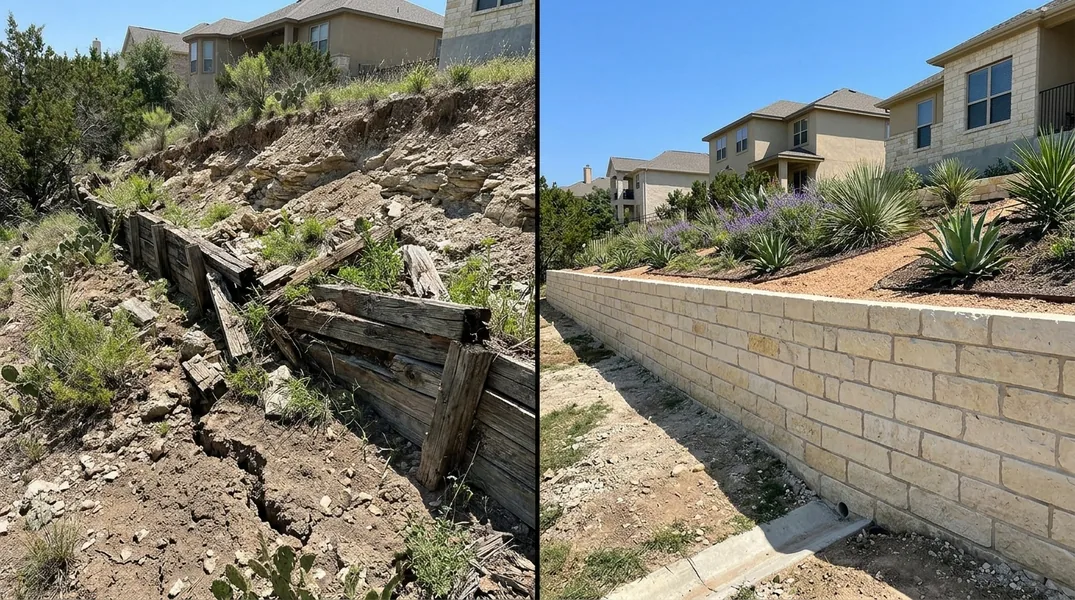
Why South Texas Storm Season Threatens Your Retaining Wall
When summer monsoons and spring thunderstorms roll through San Antonio, homeowners with retaining walls face a hidden danger that most don't think about until it's too late. Flash floods and heavy rainfall don't just damage landscapes and foundations. They create intense pressure behind retaining walls that can crack, bow, or collapse structures in a matter of hours.
The problem is especially acute in South Texas because our soil composition and climate create a perfect storm for drainage failure. When rain falls on sloped terrain behind a retaining wall, water doesn't simply drain away. Instead, it accumulates in the soil, adding weight and pushing against the wall with force that engineers call hydrostatic pressure. Without proper drainage systems in place, even a well-built wall will eventually fail under this stress.
Many homeowners don't realize that their retaining wall may already be in danger. Visible signs like small cracks, water seepage, or a slight lean in the wall structure indicate that drainage problems are already developing. If you notice these warning signs on your property, it's time to act before a major storm causes catastrophic failure.
Understanding Hydrostatic Pressure Retaining Wall Failures
Hydrostatic pressure is the force exerted by water pressing against a solid object. In the context of retaining walls, this pressure builds up when soil behind the wall becomes saturated with water and cannot drain properly. Think of it like filling a bucket with water and placing it against a wall. The water doesn't just sit there passively. It pushes with increasing force the deeper the water level gets.
When soil becomes waterlogged, its weight increases dramatically. A cubic foot of dry soil might weigh around 100 pounds, but saturated soil can weigh 130 pounds or more. Multiply this across the entire height and length of your retaining wall, and you're looking at thousands of pounds of additional lateral force pressing against the structure. Over time, this pressure exceeds what the wall was designed to withstand, leading to structural failure.
The danger intensifies during South Texas' heavy rain events. A single afternoon thunderstorm can drop several inches of rain in a short period, creating conditions where the soil behind your wall becomes supersaturated. If your wall lacks proper drainage, the water has nowhere to go but to keep accumulating, building pressure that can crack concrete, shift stone, or bend steel reinforcement. This is why Retaining Wall Repair calls often spike after major storms in our region.
The Critical Role of Retaining Wall Drainage Systems
The solution to hydrostatic pressure problems is straightforward in principle but requires professional execution: water must be managed and directed away from the wall. This is where proper retaining wall drainage becomes essential. A well-designed drainage system prevents water from accumulating behind the wall in the first place, eliminating the pressure that causes failure.
The most effective drainage solution is a retaining wall French drain, a system that's been used in construction for over a century because it works. A French drain is a perforated pipe installed at the base of the wall, surrounded by gravel and a filter fabric. Water that would otherwise pool behind the wall flows into the perforations and is channeled safely away from the structure. This simple but elegant system can mean the difference between a wall that lasts decades and one that fails after a single bad storm season.
Beyond French drains, proper retaining wall drainage includes surface water management. Grading the landscape so that rainwater runs away from the wall, installing gutters and downspouts that direct roof water away from the structure, and using permeable landscape materials all contribute to keeping water away from your wall. When all these elements work together, they create a comprehensive drainage strategy that protects your retaining wall from the intense storms that Alamo Heights and surrounding areas experience.
How Flash Floods Accelerate Retaining Wall Damage
Flash flooding presents a different but equally serious threat to retaining walls. Unlike gradual rainfall that allows water to percolate through soil, flash floods deliver massive volumes of water in a very short time. When this happens uphill from your retaining wall, the results can be catastrophic.
During a flash flood event, water doesn't just accumulate behind the wall. It rushes toward it with kinetic energy, carrying soil, debris, and rocks that can impact the structure with tremendous force. If your wall lacks adequate drainage or if surface water management is poor, the wall becomes a dam holding back a reservoir of water and saturated soil. The hydrostatic pressure can spike to levels far exceeding what the wall was designed to handle.
We've seen this scenario play out repeatedly in South Texas neighborhoods. A severe thunderstorm dumps several inches of rain in thirty minutes, water flows downslope toward a retaining wall, and within hours the homeowner discovers cracks, bulging, or complete failure of the structure. In some cases, the damage is so severe that Retaining Wall Replacement is the only option. This is why prevention through proper drainage installation during the initial Retaining Wall Installation is so much more cost-effective than dealing with failure after the fact.
Signs Your Retaining Wall Has Drainage Problems
Recognizing the early warning signs of drainage failure can save you thousands of dollars in repairs or replacement costs. The most obvious sign is visible water seepage or dampness on the wall face, especially if it appears after rain. This indicates that water is moving through the soil behind the wall and finding its way through cracks or gaps in the structure.
Other warning signs include cracks that form in a stair-step pattern, horizontal cracks that suggest pressure is pushing the wall outward, or a noticeable lean or bulge in the wall face. You might also notice that soil behind the wall appears waterlogged or muddy long after rain has stopped, or that vegetation behind the wall is unusually lush or dying (depending on whether the soil is oversaturated or eroding). Small pebbles or soil particles appearing at the base of the wall can indicate internal erosion caused by water movement.
If you observe any of these signs, don't wait for the next storm to see if the problem gets worse. Contact San Antonio Retaining Wall at (726) 200-6830 to schedule a free estimate. Our team can assess your wall's drainage situation and recommend solutions before a major storm causes failure. Early intervention is always the best approach.
Protecting Your Retaining Wall Before Storm Season Arrives
As South Texas enters its storm season, now is the ideal time to inspect your retaining wall and ensure it has adequate drainage protection. Whether your wall is brand new or several years old, proper drainage maintenance is essential. If your wall was installed without a French drain system, adding one during a pre-season inspection can prevent disaster during the intense rainfall events we experience.
For homeowners considering new construction or planning to add a retaining wall to their property, investing in professional-grade drainage from the start is non-negotiable. Concrete Retaining Walls and other durable structures still require proper drainage to perform as designed. The cost of incorporating drainage during installation is minimal compared to the expense of repairing or replacing a failed wall.
San Antonio Retaining Wall specializes in designing and installing retaining walls with drainage systems that handle South Texas weather. Our team understands the local soil conditions, rainfall patterns, and the specific challenges that homeowners face in our region. Whether you need a new installation with proper drainage, repairs to an existing wall, or a complete assessment of your current structure's vulnerability, we're here to help. Call us at (726) 200-6830 or visit our website to request your free estimate today.
Looking for a professional retaining wall contractor in San Antonio? San Antonio Retaining Wall responds fast for all your retaining wall needs.
Get a Free QuoteOur services: Retaining Wall Installation · Retaining Wall Repair · Retaining Wall Replacement